8th September 2026
Peace and Reconciliation in Testing Times: How do we bring peace together in solidarity?
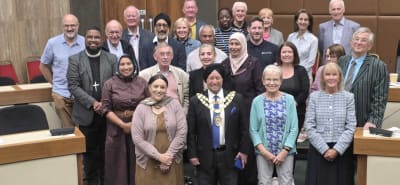
Canon Nitano Muller was a Guest Speaker at the Solihull Faiths Forum AGM at the Solihull Council Chamber on 7th September, where he gave a talk on "Peace and Reconciliation in Testing Times: How do we bring people together in solidarity?" you can read the speech below:
"Distinguished guests, interfaith friends.
It is indeed a privilege and personal honour to be with you in this capacity this evening to speak to you about Peace and Reconciliation at this AGM. Thank you for the invitation (and to my good friend, Revd Nick Parker, for making the connection).
Friends, Indulge me this evening...
I am not entirely sure that this is a good time to be talking about peace.
The world seems to be on fire, wouldn’t you agree?
Wars continue in real time as we gather this evening.
Millions suffer around the world because of where they were born, the religion they practise, the colour of their skin and/or the borders they happen to live within.
We observe that so much of that suffering on our tv and mobile phone screens before we’ve even had our morning coffee.
We hear political language becoming harsher.
Communities becoming increasingly anxious. And everywhere we seem to hear the same grammar:
Us and them.
Our people and their people.
So, what does it mean to stand in a City Council Chamber in 2026 and talk about peace and reconciliation? Isn't it rather naïve? Perhaps even a little embarrassing?
When the world is on fire, what use are words like forgiveness, justice, reconciliation? Of what use is an interfaith forum? What use is a cathedral? What use is a prayer?
I want to suggest this evening that this is precisely when we have to talk about peace and reconciliation.
Not because the world is peaceful. But because it isn't.
And the question before each of us is
“How do we become people who can still imagine peace when the world is on fire?”
The relationships between our communities represented here are not peripheral to the work of peace-building, but central! And that is what I want to talk about tonight.
Connection to Coventry
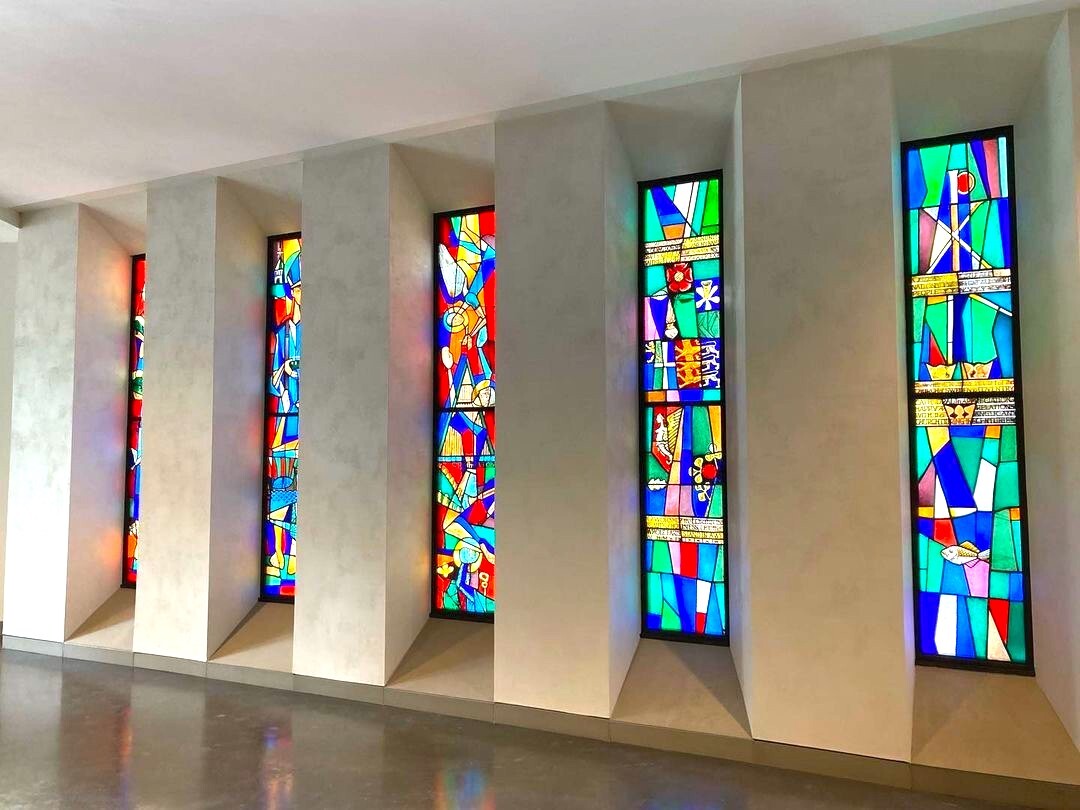
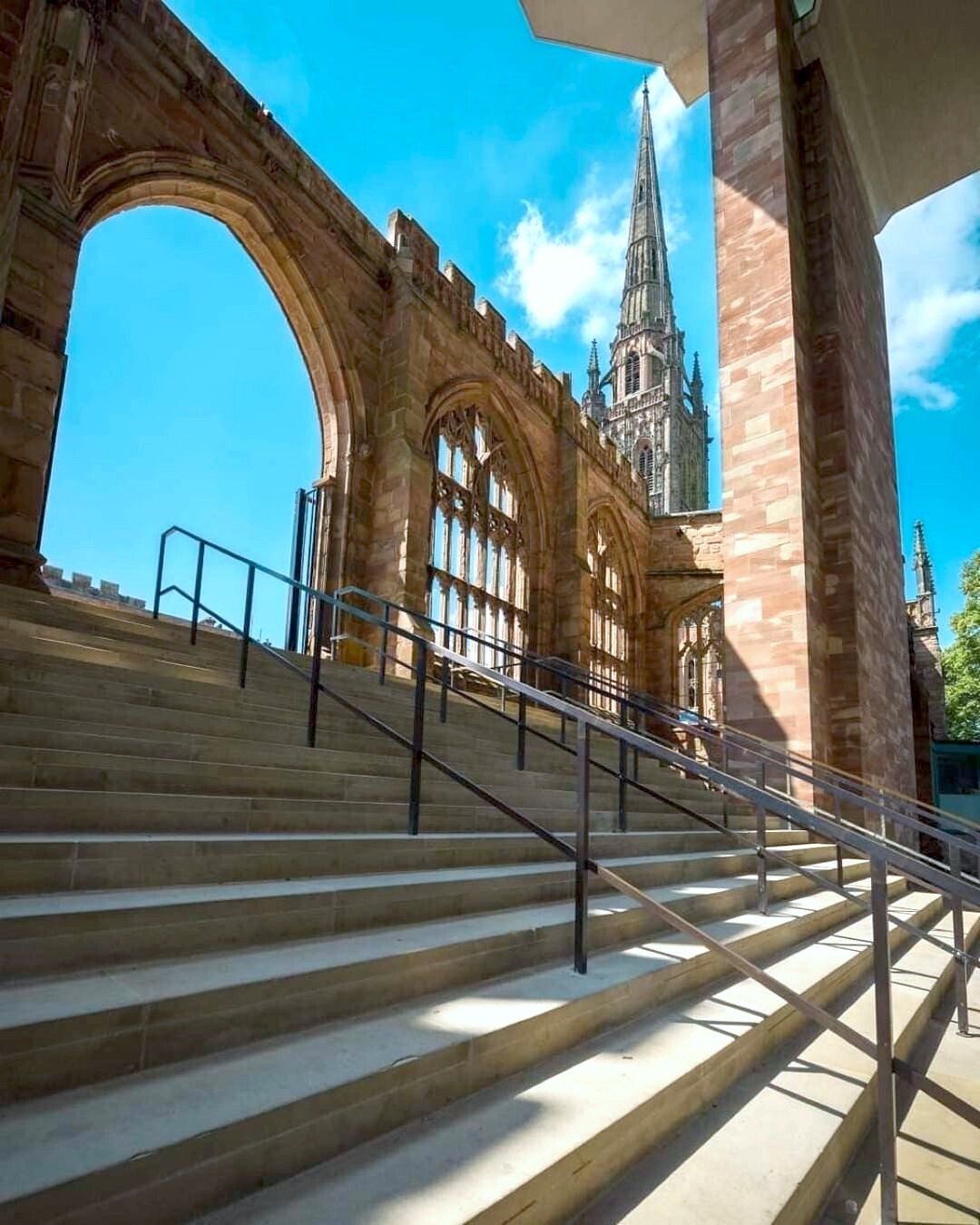
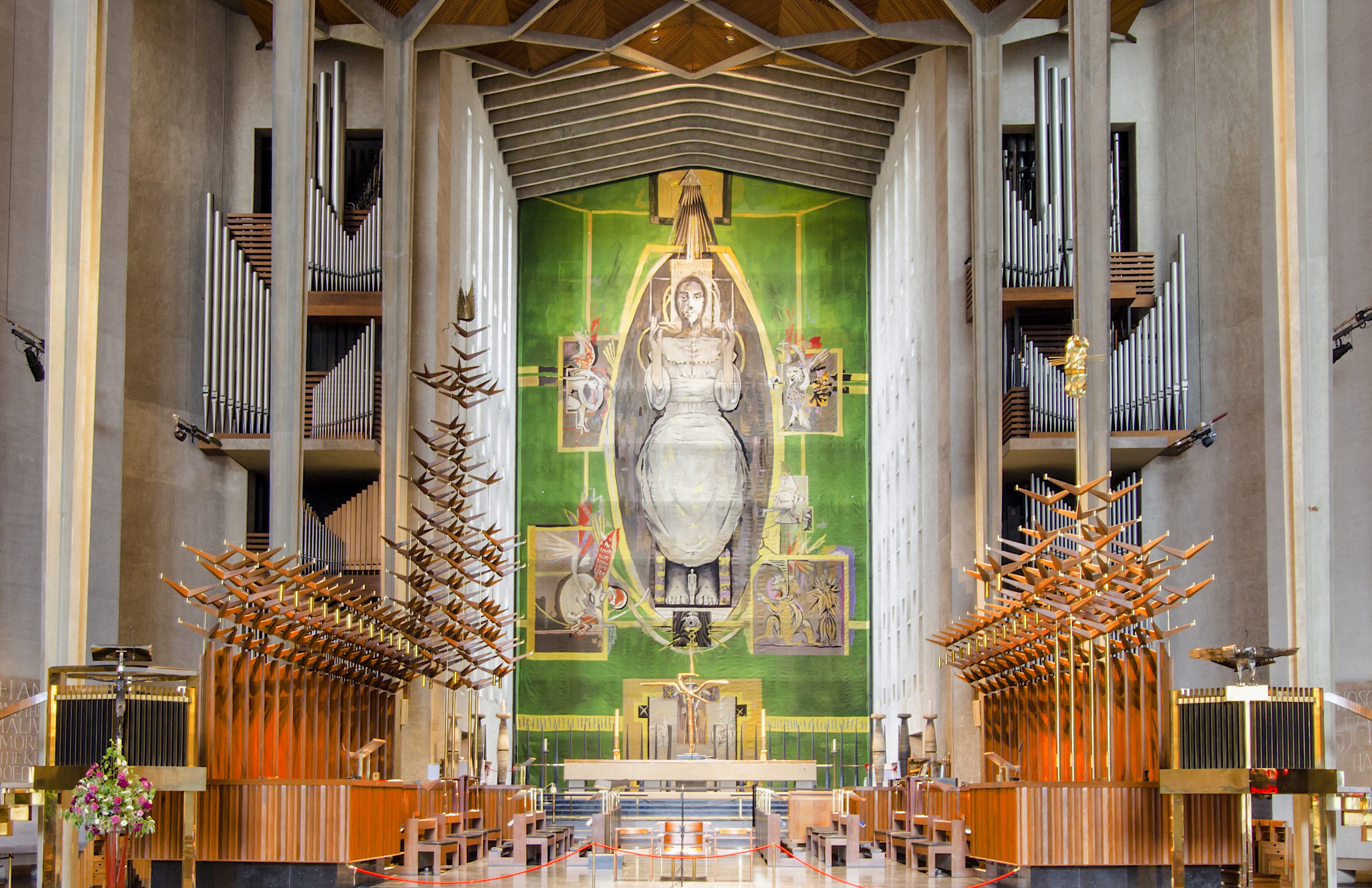
I have the privilege of working as a Canon at Coventry Cathedral. The priest responsible for worship and welcome. Every day I walk between two buildings which, in some ways, tell two completely different stories.
One is a ruin. The other is a new cathedral.
Between them, as many of you will already know, is a story of destruction and rebuilding. On the night of 14 November 1940, at the height of the second world-war, Coventry was destroyed by intense bombing that lasted about 12 hours.
The medieval Cathedral of St Michael was destroyed. And in the morning, while walking through the smouldering rubble, Provost Richard Howard (leader of the Cathedral at the time) made a decision which was remarkable in those circumstances.
He decided that Coventry's response would not be revenge. I don’t think he knew exactly what the response would be at that point, but it would not be revenge.
On the charred wall behind the ruined altar he had the words written:
Father Forgive. Words that any Christian would have recognised because they were words spoken by Jesus of Nazareth on the cross on that first Good Friday in reference to those who were executing him. Jesus uses the full phrase “Father forgive them for they know not what they do”
Dick Howard uses simply Father, forgive, Not: Father, forgive them
Simply: Father Forgive.
Two words. And yet perhaps two of the most courageous words ever written on a wall.
Because they do not pretend that nothing happened.
The Cathedral really was destroyed.
People actually died.
Families really suffered.
The city really was devastated.
Coventry did not deny the wound. But it refused to allow the wound to determine the future. And that, I think, is where reconciliation begins.
Asking: Given what has happened, what do we choose to become now?
That question has echoed through Coventry's story ever since.
From the ruins came the Cross of Nails. Three nails bound together as a symbol of our call to be reconciler, which we wear proudly as the clergy of the cathedral.
From the Cross of Nails came a community of reconciliation stretching across the world, numbering about 300 today, many of them in Germany, USA, New Zealand, South Africa and the Middle East. And the Cathedral's ministry developed around three simple but demanding commitments:
- Healing the wounds of history.
- Learning to live with difference and celebrating diversity.
- And building a culture of peace with justice.
Reconciliation is not conflict avoidance.
It is the courageous decision to remain human in the presence of conflict or disagreement.
Connection to South Africa
And I come to that story carrying another history.
I am South African, with its own history of apartheid and colonial legacy.
And so, for me, reconciliation is more than theology. It is part of the history of the country, its people and its story that has shaped me. South Africa knows what happens when difference becomes a weapon.
Apartheid, as a system, did not simply separate people. It taught people to see one another differently. It turned racial categories into political, economic, geographical and human realities. It built walls between people and then tried to persuade us that those walls were natural. And then, remarkably, South Africa began the difficult journey of imagining itself differently.
At the centre of that story was a man I want to honour today, whose voice became known around the world. The late Archbishop Desmond Mpilo Tutu. It’s no coincidence that today (7 September 1986) marks 40 years since he was installed as the first black Anglican Archbishop of Cape Town. An event that sent shockwaves through the Anglican world and indeed the political world too.
And I had the extraordinary privilege of serving as his personal chaplain for two years in 2020 and 2021 (when the COVID pandemic broke out). Every Thursday, I would visit Archbishop Tutu and Mama Leah for prayers at midday.
We prayed. We talked. We laughed.
Sometimes there was very little to say.
And as he became older, there were moments when the great Archbishop of the struggle against apartheid needed help with very ordinary things. He struggled to tie his shoelaces. And so I would find myself sitting at his feet. Literally.
Tying the shoelaces of one of the great moral figures of the twentieth century.
And I think there is something wonderfully theological about that image.
Because I had gone there expecting to learn about the great things.
Freedom. Justice. Reconciliation. Courage. And I did.
But I also learned that the great Archbishop was simply a human being.
In need of another person's hands. And perhaps that is where reconciliation begins.
Not with “the other”. With another human being.
Connection to the Tutu experience
It is very easy to talk about communities.
Muslims. Christians. Jews. Hindus. Sikhs.
People of faith. People of no faith.
Conservatives. Progressives.
We create categories because categories help us understand the world.
But categories become dangerous when they stop us seeing the person.
Because behind every category, every statistic, every news headline is a human being.
Someone whose life is considerably more complicated than the label we have given them.
Tutu understood that.
He had an extraordinary capacity to see the human being standing in front of him.
And that matters enormously in a world increasingly organised around the idea of the other. And so I honour him and his legacy today.
I remember one conversation with him particularly vividly.
We were talking about the struggle in South Africa. We spoke about the enormous pressure that had been placed upon him to remain quiet because of the threats. And what struck me was that he never confused courage with the absence of fear.
He knew fear and danger.
But he also understood that silence has consequences. Because if we are serious about peace, we have to be serious about justice.
Peace without justice is not peace. But neither is justice enough on its own.
If justice becomes only about defeating the other, then we remain imprisoned by the same logic of us and them. The challenge is to hold justice and reconciliation together.
Truth and mercy. Accountability and hope. Memory and possibility.
That was one of the great challenges of South Africa's Truth and Reconciliation Commission. There had to be an element of brave truth-telling. Victims came carrying stories of torture, imprisonment, disappearance and murder.
The country had to look at itself.
Connection to Faith Leaders
And this brings me to the particular responsibility of people of all faith groups because I think the world needs faith communities now more than ever. But it does not simply need faith communities that are good at looking after their own.
It needs faith communities that can model another way of living.
We are living through a time when the language of us and them is becoming increasingly powerful. Higher walls. Harder borders. Suspicion. Fear.
And faith communities are not immune: Sometimes that language comes into and from our own congregations. And I believe faith leaders have a particular responsibility to challenge it.
Not simply when it comes from somebody else's tradition.
But when it comes from our own.
That is much harder.
To say: Our faith does not permit us to speak about people in that way. Our tradition calls us to something better. Our scriptures cannot be used to justify contempt.
And sometimes, when we do that, we will be accused of betrayal.
There is a saying in reconciliation work:
“You know you are doing reconciliation when your own people accuse you of betraying them.”
It is uncomfortable.
But perhaps reconciliation is supposed to be uncomfortable.
Because it places us between communities.
It asks us to remain rooted in our own tradition while reaching out to another.
And that distinction matters.
I do not think interfaith dialogue requires us to become less Christian.
Muslim. Hindu. Sikh. Jewish. Or less committed to whatever tradition has formed us.
In fact, I think we need precisely the opposite.
We need to be rooted enough to reach out.
Secure enough in our own tradition that another person's faith does not threaten us.
Deep enough in our own convictions that we can listen courageously without becoming defensive.
The Golden Rule
Across the world's great religious traditions there is some form of the profound ethical intuition that we should treat others as we ourselves would wish to be treated.
For Christians, Jesus puts it very simply:
“Do to others as you would have them do to you.”
But perhaps, in an interfaith context, we can hear that in an even more demanding way.
Learn to see the other person as you would wish to be seen.
And so the Golden Rule asks me to offer you exactly the same gift. To allow you the dignity of telling your story, which is key in the work of peace-building and reconciliation.
Connection to Scholars in Reconciliation
One of the great insights of the peace-builder John Paul Lederach is that conflict is never simply about issues.
It is about relationships. And therefore, reconciliation cannot simply be about solving the problem in front of us. It has to attend to the relationships underneath it.
Lederach speaks about the moral imagination: the ability to imagine ourselves within a web of relationships that includes even those whom we regard as opponents, and to imagine possibilities beyond the patterns of division that currently seem inevitable.
And I think storytelling is one of the ways we develop that imagination.
Because when you tell me your story, you cease to be an abstraction. You become a person. I begin to see that the world looks different from where you are standing.
And that does something to me, perhaps even changes me.
It shapes my empathy and compassion. And, if I allow it to, it shapes my worldview.
So perhaps when we gather around a table like tonight, we gather first not as representatives of competing theological systems.
We gather as human beings with stories. And our stories become the medium through which we encounter one another. Because once I know your story, it becomes harder to dismiss you. Once I know your name, you become harder to turn into a category. Once I have heard your pain, I have a responsibility to it.
So let me turn the challenge directly towards the faith leaders in this room.
What does it actually mean to be involved in interfaith dialogue at a time in our history that sees so much polarization on full display?
Is it enough to attend one another's events?
To exchange greetings at festivals?
To have a photograph together?
Those things matter but perhaps they are only the beginning.
What would happen if we became genuinely curious about one another?
What would happen if we created spaces where people could tell their stories?
What would happen if we were prepared to hear difficult things about our own traditions?
What would happen if we could disagree without becoming defensive?
Because that is where interfaith dialogue becomes peace-building. We stop simply learning about one another. We begin becoming responsible to one another.
At Coventry, like South Africa where I come from, we do not have all the answers.
But we do have a model. A way of being, that I hope will inspire many to imagine a different future.
As the faith leaders, the custodians and stewards of tradition, the storytellers of our time, we have a moral obligation to build what Provost Dick Howard called a: Kinder, simpler, more Christlike sort of world. I pray that each of you are provided with all the tools necessary by the Source and Fountain of all good things to make that happen in your homes, your places of worship, faith communities and in this City of Solihull.
I thank you."