22nd June 2026
“Why Windrush Matters at Coventry Cathedral”
The Reverend Nitano Muller, Canon for Worship and Welcome, 22 June 2026
The first thing that struck me was the sound.
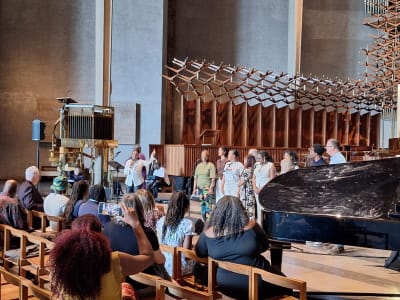
Before a single speech had been made, before the first prayer was offered, the Cathedral was already alive with the rhythms of Windrush. Saxophone melodies drifted through the Nave. Gospel harmonies rose into the rafters. Steel pans waited patiently for their moment. Later, voices young and old would sing This Little Light of Mine and Oh Happy Day, songs that have carried generations through struggle and resistance with immense faith and joy.
And then there were the flavours. As the service concluded, people gathered around tables at the back of the Nave, sharing food, catching up on stories and lots laughter. The Cathedral was filled not only with music, but with hospitality. Not only with remembrance, but with community.
It was a glimpse of the Kingdom of God!
Every year, people ask why Coventry Cathedral continues to mark Windrush. Surely, some suggest, this is history now. Surely the story has been told.
But that question reveals precisely why remembrance matters.
The story of Windrush is not merely about a ship that arrived in Bristol in 1948. It is the story of people who answered Britain's call and helped build modern Britain. It is the story of nurses who cared for the sick, teachers who educated future generations, workers who rebuilt cities after war and Christians who brought vibrant traditions of worship and witness into our churches.
It is also the story of spoken and unspoken prejudice, exclusion and visceral injustice. It is the story of people who were invited to belong and then made to feel that they did not. To remember Windrush is therefore an act of truth-telling.
At Coventry Cathedral, this matters deeply because it speaks directly to who we are.
One of our priorities is healing the wounds of history. Healing cannot happen without memory. Wounds ignored do not disappear; they simply deepen beneath the surface, especially when it is not treated. We recognise that the ministry of reconciliation begins by listening honestly to stories that have too often been overlooked or forgotten. Windrush invites us to listen again.
Another of our priorities is learning to live with difference and celebrating diversity. The Cathedral's Windrush commemoration is much more than an event for Black communities, which is why I was partly relieved but also overjoyed to see white siblings standing in solidarity in the pews. It is a gift offered to the whole city. It reminds us that diversity is not a problem to be managed, as the anti-immigrant narrative so boldly purports, but diversity is a blessing to be received. The sounds, traditions, languages, cultures and faith expressions that filled the Cathedral are definitely not additions to British life. They are part of British life.
As I looked around the congregation, I saw something profoundly hopeful. School pupils sharing reflections alongside community leaders. Pastors, the local councillor, artists and activists standing together. Different generations gathered in one place. Difference was not erased. It was celebrated! Yet we were united by a shared commitment to dignity, belonging and justice.
This, too, is reconciliation.
Our third priority is building a culture of justice and peace. This year's service included readings, reflections and music, but at its heart was a challenge. The reading from Exodus spoke of a God who sees suffering, hears cries for help and calls people to confront oppression. It is one of the most powerful passages in Scripture because it reminds us that God is not neutral in the face of injustice.
"I have observed the misery of my people. I have heard their cry."
The God of Exodus remembers.
If we are serious about peace, we must be serious about justice. If we are serious about reconciliation, we must be serious about truth-telling and Windrush calls us to both.
As Canon for Worship and Welcome, this commemoration sits at the very heart of my ministry. Worship and reconciliation are sometimes treated as separate concerns. One belongs to the sanctuary; the other belongs to the public square.
I do not believe that.
The worship of God and the work of reconciliation belong together. Worship teaches us to see one another as God sees us. Reconciliation teaches us what faithful worship requires of us. Every prayer for peace, every hymn of praise, every blessing pronounced in God's name must ultimately shape how we live together as neighbours.
That is why the Windrush service belongs in our Cathedral.
The Cathedral is a place where history is remembered. It is also a place where history is transformed. Where painful stories are spoken aloud- again and again, until someone, maybe even God hears us afresh. Where God's future breaks into the present.
Beneath all that took place, was something deeper: a conviction that remembrance is an act of hope.
We remember not because we are trapped by the past, but because we believe a better future is possible.
A future in which wounds are healed.
A future in which difference is celebrated.
A future in which justice and peace embrace.
That is the work of reconciliation.
That is the work of the Cathedral.
And that is why we will continue to remember Windrush.